JavaScript Try Operator Explained: A New TC39 Stage-1 Proposal for Better Error Handling
AI Summary
Get a quick AI-generated summary of this blog post in seconds.
The New JavaScript try Operator Proposal Explained (TC39 Stage-1)
Introduction
JavaScript has evolved significantly over the past decade. Features like async/await, optional chaining, nullish coalescing, top-level await, and private class fields have improved developer experience and made the language more expressive.
However, one area that still causes friction in modern JavaScript applications
is error handling. Today, JavaScript primarily relies on
exceptions and try...catch blocks to manage runtime errors.
While this mechanism works, many developers find it verbose and sometimes difficult
to compose when working with asynchronous operations or multiple operations that
may fail. In real-world applications like APIs, file processing, database queries,
or network requests, developers often end up writing many try...catch
blocks which can make the code harder to read and maintain.
To explore better approaches to error handling, a new proposal called the
JavaScript try operator has been introduced and is
currently at TC39 Stage-1. The goal of this proposal is to allow
developers to convert thrown errors into structured values, making error handling
cleaner and easier to compose.
Before understanding the proposal itself, it is helpful to understand how JavaScript features are introduced and approved.
How JavaScript Features Get Approved (TC39 Process)
JavaScript is standardized by a group called TC39. TC39 stands for Technical Committee 39, which operates under ECMA International, the organization responsible for maintaining the ECMAScript specification.
The ECMAScript specification defines how JavaScript behaves. Browser engines such as Chrome’s V8, Firefox’s SpiderMonkey, and JavaScript runtimes like Node.js implement this specification.
Who participates in TC39?
TC39 consists of engineers from major technology companies including Google, Microsoft, Apple, Mozilla, and other organizations that build JavaScript engines or large-scale applications.
These engineers collaborate to discuss ideas, propose new features, evaluate technical details, and refine designs before they become part of the JavaScript language.
The TC39 Proposal Stages
Every new JavaScript feature goes through a structured proposal pipeline before being added to the language.
Stage 0 – Strawman
This is the early idea stage. Anyone can suggest a potential feature. Many ideas never move beyond this phase.
Stage 1 – Proposal
At this stage, the problem is clearly described and possible solutions are explored. Community feedback is gathered and the feature begins active discussion.
The JavaScript try operator proposal is currently at Stage-1.
Stage 2 – Draft
The proposal becomes more structured. Syntax, semantics, and edge cases are defined. JavaScript engine developers may begin experimental implementations.
Stage 3 – Candidate
The feature is considered mostly complete. Implementations may appear in browsers behind flags for real-world testing.
Stage 4 – Finished
The proposal becomes part of the official ECMAScript standard and is implemented in JavaScript engines.
Problems with the Current try...catch
1. Block Scope Limitations
The try...catch statement introduces its own block scope. Variables
declared inside the block cannot easily be accessed outside of it.
try {
  const user = await getUser()
} catch (err) {
  console.error(err)
}

console.log(user) // not accessible
To solve this, developers often declare variables outside the block, which can make the code less clean.
2. Too Much Boilerplate
Sometimes a full try...catch block feels heavy for simple operations.
let user

try {
  user = await fetchUser()
} catch (err) {
  console.error(err)
}
This pattern appears frequently in production applications and can add unnecessary boilerplate.
3. Nested Try Blocks
When multiple operations may fail, developers sometimes end up with nested
try...catch blocks.
try {
  const user = await getUser()

  try {
    const posts = await getPosts(user.id)
  } catch (err) {
    console.error("Post error", err)
  }

} catch (err) {
  console.error("User error", err)
}
This structure quickly becomes harder to read and maintain.
4. Exceptions vs Value-Based Errors
JavaScript primarily uses exceptions. However, many modern languages prefer value-based error handling.
Examples include:
- Rust →
Result - Go →
(value, error) - Swift →
Result
These patterns treat errors as normal values instead of thrown exceptions.
The Proposed JavaScript try Operator
The proposal introduces an expression-level try operator.
Instead of throwing exceptions, it converts them into structured results.
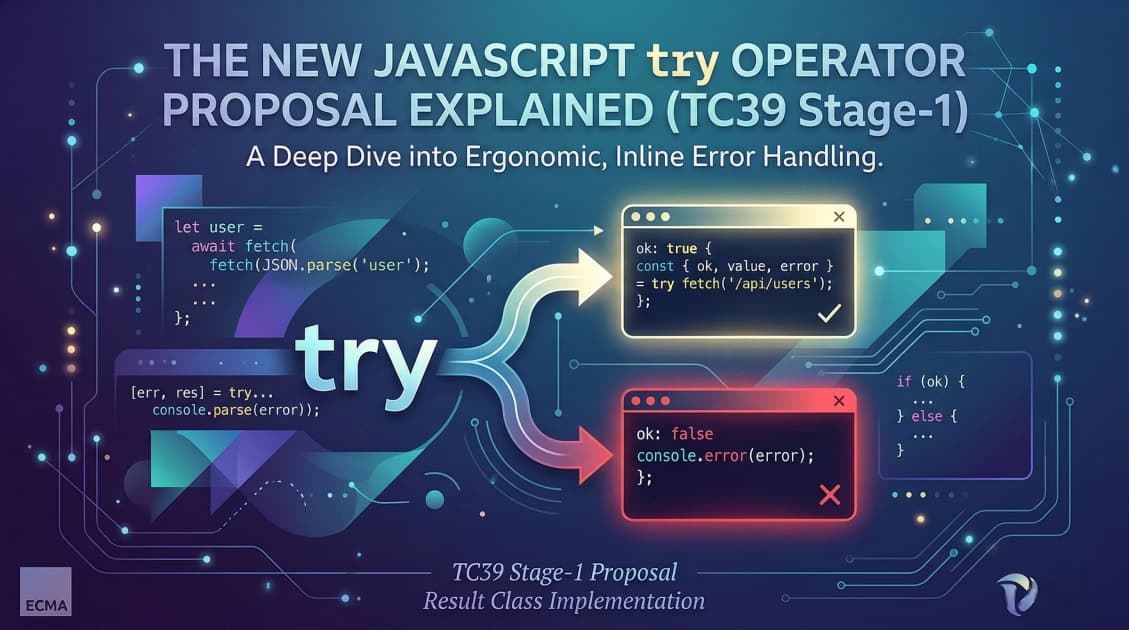
const { ok, error, value } = try await fetch("/api/users")
If the operation succeeds:
ok = true
value = result
error = undefined
If the operation fails:
ok = false
value = undefined
error = thrown error
Array Destructuring Example
The proposal also supports array-style destructuring.
const [ok, fetchErr, res] = try fs.readFileSync("data.txt")
This style is similar to error handling patterns used in languages like Go.
Why This Proposal Is Interesting
Cleaner Code
Instead of writing large try...catch blocks, developers could handle
errors in a single expression.
Less Nesting
Multiple operations can be handled without deeply nested error handling blocks.
Better Composition
Developers can compose operations more easily when errors are returned as values.
Important Notes
The proposal does not replace try...catch. Traditional
exception handling will continue to exist. The new operator simply provides another
way to convert exceptions into values when needed.
Since this feature is still in TC39 Stage-1, the syntax and behavior may change before it becomes part of the language.
Conclusion
JavaScript continues to evolve through the structured TC39 proposal process. New ideas are carefully explored and refined before becoming part of the language.
The JavaScript try operator proposal explores a new
approach to error handling by converting exceptions into structured values that
can be handled directly within expressions.
While the proposal is still in its early stages, it highlights an important discussion in the JavaScript ecosystem: how to make error handling simpler, cleaner, and easier to compose in modern applications.
Whether the try operator eventually becomes part of JavaScript or not,
it represents the continuous effort by the community to improve developer
experience and evolve the language for modern development.
Frequently Asked Questions
What is the JavaScript try operator proposal?
The JavaScript try operator is a TC39 Stage-1 proposal that introduces expression-level error handling. Instead of using a traditional try...catch block, developers could use try to capture errors and return a structured result containing ok, value, and error.
What problems does the try operator solve in JavaScript?
The proposal aims to reduce common issues with try...catch such as excessive boilerplate code, nested try blocks, and variable scope limitations. It allows developers to handle errors directly in expressions, making code cleaner and easier to maintain.
Is the JavaScript try operator available now?
No. The try operator is currently a TC39 Stage-1 proposal, which means it is still under discussion and may change before becoming part of the JavaScript language.
Will the try operator replace try...catch?
No. The proposal does not replace try...catch. It simply provides an alternative approach where errors are converted into structured values instead of exceptions.
How does the try operator work?
The operator evaluates an expression and returns a structured result instead of throwing an exception. const { ok, value, error } = try await fetch("/api/users") If the operation succeeds, ok becomes true and value contains the result. If it fails, ok becomes false and error contains the exception.
Categories
Subscribe to Our Tech Newsletter
Get the latest articles on Frontend, Backend, Cyber Security, Blockchain, and more delivered straight to your inbox. No spam, ever.