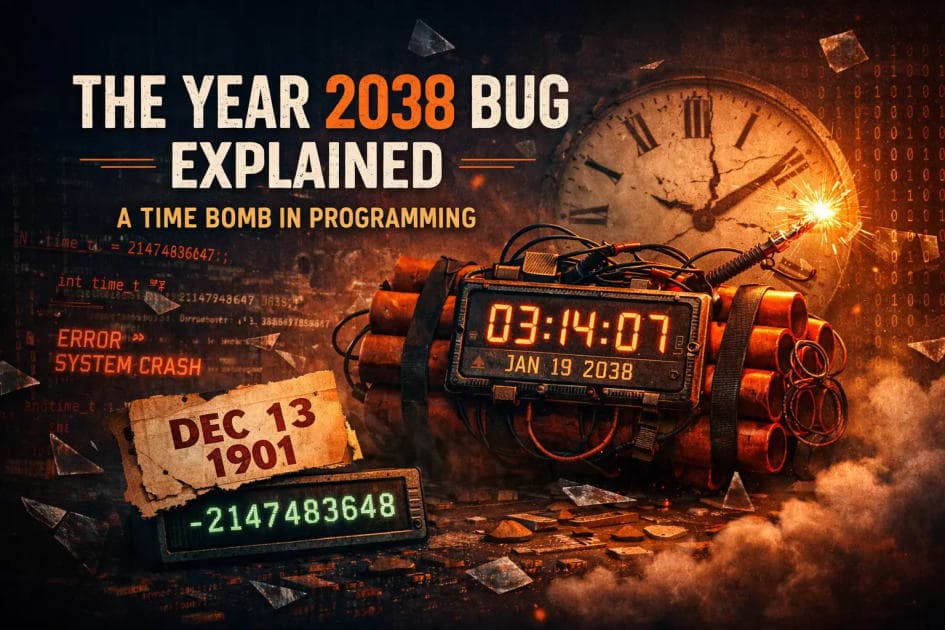
The Year 2038 Bug: A Time Bomb in Modern Programming
AI Summary
Get a quick AI-generated summary of this blog post in seconds.
In the tech world, we often talk about the future as a land of infinite possibilities. But for many legacy systems and embedded devices, the future has a very specific expiration date: January 19, 2038. This isn't a prophecy or a marketing stunt. It is a mathematical certainty rooted in how computers have stored time for over fifty years. We call it the Year 2038 bug, or more dramatically, the Epochalypse.
If you remember the Y2K scare, you might be tempted to roll your eyes. However, the Year 2038 bug is fundamentally different. While Y2K was largely about a shortcut in date formatting (using two digits for years instead of four), the 2038 issue is a hardware and architectural limitation. It is built into the very foundation of the Unix operating system and the C programming language, both of which power everything from your smart toaster to the servers running global stock exchanges.
Understanding this bug requires us to look under the hood of how computers count. It is a story of bits, integers, and the unintended consequences of early computing decisions. As we move closer to the deadline, the pressure on developers to audit and upgrade systems is mounting. This article will explain exactly why this happens, why it matters, and how we can stop the digital clock from resetting to 1901.
Table of Contents
- What is Unix Time?
- The Math of the 32-Bit Limit
- The Overflow: What Happens in 2038?
- Real-World Impact and Risks
- Y2K vs. the Year 2038 Bug
- The 64-Bit Solution
- Is JavaScript Safe?
- Testing and Simulating the Bug
What is Unix Time?
To understand the Year 2038 bug, you first have to understand how Unix-like systems (including Linux, macOS, and Android) keep track of time. Instead of storing a calendar date like "October 12, 2023," these systems use a single number called a Unix timestamp. This timestamp represents the total number of seconds that have passed since the Unix Epoch.
The Unix Epoch is defined as January 1, 1970, at 00:00:00 UTC. Every second that passes, the computer increments this counter by one. For example, if the timestamp is 60, the time is 00:01:00 UTC on January 1, 1970. This system is incredibly efficient for computers because it makes calculating the difference between two dates as simple as basic subtraction. It avoids the complexities of leap years and varying month lengths in internal calculations.
The Math of the 32-Bit Limit
In the early days of computing, memory and processing power were extremely expensive. To save space, engineers decided to store the Unix timestamp as a 32-bit signed integer. A "bit" is a binary digit (0 or 1), and a 32-bit integer uses a sequence of 32 zeros and ones to represent a number.
A "signed" integer means the first bit is used as a flag to indicate whether the number is positive or negative. This allows the system to represent dates both after 1970 (positive) and before 1970 (negative). However, using one bit for the sign leaves only 31 bits for the actual number. The maximum value you can store in a 31-bit binary sequence is 2 raised to the power of 31, minus 1. That number is exactly 2,147,483,647.
Think of it like a car's odometer that can only go up to 999,999 miles. Once you hit that limit, the next mile causes the counter to reset. In the case of a 32-bit signed integer, the "reset" is much more chaotic because of how binary math works.
The Overflow: What Happens in 2038?
The magic moment occurs on January 19, 2038, at 03:14:07 UTC. At this exact second, the Unix timestamp will reach its maximum capacity of 2,147,483,647. One second later, the system will attempt to add 1 to that value. Because the integer is signed, the binary sequence will flip its sign bit from 0 to 1.
In computer logic (specifically Two's Complement arithmetic), this causes the number to wrap around to its lowest possible negative value: -2,147,483,648. To the computer, the date will suddenly jump from early morning in 2038 back to December 13, 1901.
Here is a simple representation of the overflow in C code:
#include <stdio.h> #include <time.h> int main() { // The maximum value for a 32-bit signed integer time_t max_time = 2147483647; printf("Before overflow: %s", ctime(&max_time)); // Adding one second max_time++; printf("After overflow: %s", ctime(&max_time)); return 0; }
When this code runs on a 32-bit system, the output will show the date jumping nearly 137 years into the past. For a computer system, this is catastrophic. Scheduled tasks will fail, security certificates will expire instantly, and financial interest calculations will yield impossible results.
Real-World Impact and Risks
You might think, "Who still uses 32-bit computers?" While most modern laptops and smartphones are 64-bit, the world is full of invisible computers. These are the embedded systems found in industrial machinery, medical devices, cars, and network routers. Many of these systems were built to last decades and are rarely updated.
- Legacy Databases: Many old databases store dates as 32-bit integers. Even if the server is 64-bit, the data format itself might still be limited.
- IoT Devices: Smart home devices and industrial sensors often run on low-power 32-bit microcontrollers to save costs.
- Financial Services: Banks often use COBOL or old C-based systems for core processing. A date jump could cause massive errors in loan repayments or transaction logging.
- File Systems: Some older file systems (like early versions of EXT) store file timestamps in 32-bit format. This could lead to file corruption or the inability to save new data.
Y2K vs. the Year 2038 Bug
It is helpful to compare this to Y2K. In 1999, people feared planes would fall from the sky. That didn't happen because engineers spent billions of dollars and years of work fixing the code. However, Y2K was a formatting issue. Programmers just had to change "YY" to "YYYY" in their code logic.
The Year 2038 bug is an architectural issue. You cannot simply "patch" a 32-bit processor to suddenly handle 64-bit integers without changing how the hardware interacts with the software. In many cases, the fix requires replacing the entire hardware unit or migrating to a completely new operating system kernel. It is a more deeply embedded problem that requires a fundamental shift in how data is stored.
The 64-Bit Solution
The solution is straightforward but requires significant effort: move to 64-bit integers for timekeeping. A 64-bit signed integer can hold a maximum value of 9,223,372,036,854,775,807. To put that in perspective, a 64-bit Unix timestamp won't overflow for another 292 billion years. By then, our sun will have long since burned out.
Modern Linux kernels (version 5.6 and later) have introduced fixes to allow 32-bit systems to use 64-bit time variables. This is a massive step forward for the longevity of embedded Linux devices. Developers are encouraged to use time_t abstractions instead of hard-coding integer sizes, allowing the compiler to choose the safest size for the target architecture.
Is JavaScript Safe?
Web developers often ask if JavaScript is affected. JavaScript handles numbers differently than C. It uses the IEEE 754 double-precision floating-point format for all numbers. This allows JavaScript to safely represent integers up to 2 raised to the 53rd power, minus 1 (Number.MAX_SAFE_INTEGER).
Because of this, JavaScript's Date.now() (which returns milliseconds) is safe until the year 275,760. However, there is a catch. If your JavaScript code interacts with a 32-bit backend API or uses Int32Array to process timestamps, you could still run into the 2038 bug. The risk isn't in the language itself, but in the data exchange between systems.
Testing and Simulating the Bug
If you are a developer, you should proactively test your systems. You can simulate the bug by manually setting your system clock or your application's environment variables to a date just before the overflow. For example, in a Docker container or a virtual machine, you can set the date to 2038-01-19 03:14:00 UTC and observe how your application behaves over the next eight seconds.
Check your database schemas. Are you using INT for timestamp columns? If so, you might need to migrate those columns to BIGINT. Check your third-party libraries; if they haven't been updated in years, they might still be relying on 32-bit time logic.
Key Takeaway
The Year 2038 bug is a reminder that technical debt has a long shelf life. Decisions made for efficiency in the 1970s are still echoing through our modern infrastructure. While we have plenty of time to fix the issue, the complexity of embedded systems and legacy software means we cannot afford to wait until 2037. By migrating to 64-bit timekeeping now, we ensure that our digital world remains stable long into the future.
Frequently Asked Questions
What exactly is the Year 2038 bug?
It is a time-keeping limitation in 32-bit systems where the Unix timestamp reaches its maximum value and wraps around to 1901, causing software failures.
Will my modern 64-bit Windows or Mac computer be affected?
Generally, no. Modern 64-bit operating systems use 64-bit integers for time, which won't overflow for billions of years.
Why does the bug cause the date to jump to 1901?
Because of how signed integers work in binary, once the maximum positive value is reached, adding one flips the sign bit, resulting in the largest possible negative number.
Does this affect web languages like JavaScript or Python?
Most modern high-level languages use 64-bit floats or arbitrary-precision integers, making them safe. However, they can still fail if they receive 32-bit data from an older API or database.
What is the best way to prevent the Year 2038 bug?
The primary solution is to upgrade hardware to 64-bit architectures and ensure software is compiled using 64-bit time types (like a 64-bit time_t).
Categories
Subscribe to Our Tech Newsletter
Get the latest articles on Frontend, Backend, Cyber Security, Blockchain, and more delivered straight to your inbox. No spam, ever.